No Sperm, Weak Sperm, or Abnormal Sperm — Can You Still Have a Baby?
You got the semen analysis results back. And it wasn’t good news.
Maybe it said “azoospermia” — no sperm found at all. Maybe it said “oligospermia” — low count. Maybe it said “asthenospermia” — low motility. Maybe “teratospermia” — high percentage of abnormal shapes.
Or maybe it said all of the above.
And now you’re sitting in your car in the parking lot of the fertility clinic, staring at a piece of paper that feels like a death sentence, thinking: Is this it? Can I ever have kids?
Let me tell you something important, right now: the answer is almost certainly not “no.”
Male infertility diagnosis is one of the most rapidly evolving areas in all of medicine. In 2026, the treatments available are dramatically more advanced than even 10 years ago. And the assumptions people make about sperm problems are, in most cases, completely wrong.
So let’s talk about what these diagnoses actually mean, what they don’t mean, and what you can actually do about them.
🔬 What Does a Semen Analysis Actually Measure?
First, let’s understand what the test is actually measuring. A standard semen analysis evaluates several parameters:
- 📊 Volume — how much semen is produced (normal: 1.5–5 mL)
- 📊 Sperm concentration — number of sperm per milliliter (normal: 15+ million/mL)
- 📊 Total sperm count — concentration × volume (normal: 39+ million total)
- 📊 Motility — what percentage move and how well (normal: 40%+ with progressive movement)
- 📊 Morphology — what percentage have normal shape (normal: 4%+ per WHO criteria)
- 📊 Viability — what percentage are alive (normal: 58%+)
Here’s what most people don’t realize: these are population averages, not thresholds for fertility. Men with values below “normal” frequently father children. Men with “normal” values sometimes struggle. The test is a guide, not a verdict.
According to the WHO, a man is considered infertile if he has abnormal semen parameters on at least two separate occasions. One bad test is not a diagnosis.
🚫 Azoospermia: “No Sperm Found” — But Not No Sperm
Azoospermia — the complete absence of sperm in ejaculate — affects about 1% of all men and 10–15% of infertile men. It’s one of the most devastating diagnoses a man can receive. But here’s what the label doesn’t tell you:
There are two types of azoospermia, and they’re very different:
1. Obstructive Azoospermia (OA)
Sperm are being produced normally — but there’s a blockage preventing them from exiting. The testicles make fine sperm; they just can’t get out.
Common causes:
- 🔒 Congenital bilateral absence of vas deferens (CBAVD) — present from birth
- 🔒 Vasectomy — the most common cause of obstructive azoospermia
- 🔒 Infection — epididymitis or other scarring that blocks the reproductive tract
The good news: obstructive azoospermia is often correctable. Surgical reconstruction (vasovasostomy) can restore sperm flow. Or sperm can be retrieved directly from the testicle or epididymis for IVF/ICSI. A 2018 study in Fertility and Sterility found that sperm retrieval was successful in 95%+ of obstructive azoospermia cases.
2. Non-Obstructive Azoospermia (NOA)
Sperm production is severely impaired or absent. This is more challenging — but not hopeless.
Even in severe NOA, microdissection TESE (testicular sperm extraction) — a microsurgical procedure where a urologist extracts tiny amounts of testicular tissue and searches for viable sperm — finds sperm in approximately 40–60% of men.
The retrieved sperm can then be used for ICSI (intracytoplasmic sperm injection) — where a single sperm is injected directly into an egg. This bypasses the need for normal sperm count entirely.
🐢 Asthenospermia: “Weak Sperm” — Still Fixable
Asthenospermia — low sperm motility — means sperm are present but not swimming well enough to reach and fertilize the egg. It’s one of the most common causes of male infertility.
But here’s the thing: infertility treatment doesn’t require sperm to swim well on their own.
With ICSI, a single viable sperm is selected and injected directly into the egg. The sperm doesn’t need to be a champion swimmer — it just needs to be alive and have intact DNA. This single procedure has transformed what’s possible for couples facing severe male factor infertility.
A 2020 study in Human Reproduction found that ICSI with immotile sperm (sperm that don’t move at all) still resulted in clinical pregnancy rates of 35–45% — comparable to ICSI with normalmotile sperm.
🧬 Teratospermia: “Abnormal Sperm” — Overrated as a Problem
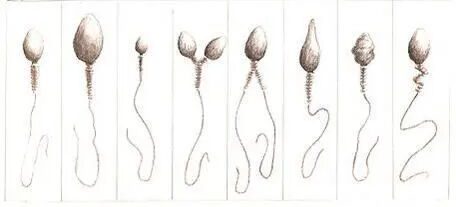
Teratospermia — a high percentage of abnormally shaped sperm — is often over-emphasized as a cause of infertility. Here’s why:
Strict morphology (Kruger strict criteria) of 4% normal forms is considered the “normal” threshold. But research has consistently shown that abnormal morphology has minimal impact on natural fertility when sperm count and motility are adequate — and zero impact when ICSI is used.
The reason: morphology is a crude measure. A sperm might look “abnormal” under a microscope but have perfectly intact DNA and full fertilizing capacity. The visual assessment is just that — visual.
However: severe teratospermia (especially with 100% abnormal forms) can indicate underlying sperm DNA damage, which is a more meaningful concern.
🧪 The Full Male Fertility Workup: What to Ask For
A semen analysis is just the beginning. A complete male fertility evaluation should include:
- 🩸 Hormone panel — FSH, LH, testosterone, estradiol, prolactin. Abnormal hormones can explain most cases of impaired sperm production
- 🧬 Karyotype — rules out genetic abnormalities like Klinefelter syndrome (47,XXY)
- 🧬 Y-chromosome microdeletion testing — rules out deletions on the Y chromosome associated with azoospermia
- 🔍 Scrotal ultrasound — evaluates testicular size, presence of varicoceles, and other structural issues
- 🦠 Infection screening — chlamydia, ureaplasma, and other infections can impair sperm production and function
- 🧬 Reactive oxygen species (ROS) testing — elevated oxidative stress damages sperm DNA
- 🧬 DNA fragmentation index (DFI) — measures the percentage of sperm with damaged DNA. High DFI is associated with poor IVF outcomes and increased miscarriage rates
The most commonly missed diagnosis: varicoceles. A varicocele is a dilation of the veins draining the testicle — present in 40% of infertile men. They cause heat, oxidative stress, and impaired sperm production. And they’re correctable with surgery in most cases.
🥗 What Actually Improves Sperm Quality
Here’s the good news: sperm are produced every 64–72 days. That means every couple of months, you have a chance to produce better sperm — based on what you’ve been doing in the intervening period.
Evidence-based ways to improve sperm quality:
- 🥬 Antioxidants — CoQ10 (200–400mg/day), vitamin C (500mg), vitamin E (400IU), selenium (200mcg), and zinc (30mg) have all been shown in RCTs to improve sperm count, motility, and morphology. A 2021 meta-analysis in Reproductive Biology and Endocrinology confirmed antioxidant supplementation significantly improves live birth rates in male factor infertility
- 🐟 Omega-3 fatty acids — associated with improved sperm count and motility in multiple studies
- 🥬 Leafy greens and folate — folate is critical for DNA synthesis in developing sperm
- 🚫 Eliminate heat — hot tubs, saunas, tight underwear, laptops on lap, long bike rides all heat the testicles and impair sperm production
- 🚫 Eliminate endocrine disruptors — BPA, phthalates, pesticides, and other environmental toxins impair sperm DNA. Switch to glass storage, organic produce, and filtered water
- 💊 Address varicoceles — microsurgical varicocelectomy can improve sperm parameters by 40–60%
✅ The Modern Fertility Toolbox: What Can Actually Help
Depending on your specific diagnosis, here are the treatment options available in 2026:
For Mild–Moderate Male Factor
- 💊 Clomiphene citrate or letrozole — stimulates the body’s own testosterone and sperm production
- 💊 Human chorionic gonadotropin (hCG) — directly stimulates testicular function
- 🦠 Treatment of underlying infections
- 🔧 Surgical correction of varicoceles
For Severe Male Factor
- 🧪 Intrauterine insemination (IUI) — sperm are “washed” and concentrated, then placed directly in the uterus. Works for mild-moderate issues
- 🧪 IVF with ICSI — a single sperm is injected into each egg. This bypasses almost every male factor problem, including low count, low motility, and even some DNA fragmentation
- 🧬 TESE or microdissection TESE — surgical sperm retrieval for azoospermia, followed by ICSI
- 🧬 Donor sperm — in rare cases where no sperm can be retrieved, donor sperm with IUI or IVF remains an option
💡 The Bottom Line
Here’s the reframe that matters most: male infertility is not a diagnosis. It’s a description.
It describes a set of laboratory findings. It does not describe your future. It does not describe what’s possible with modern medicine, with the right treatment, with the right doctor, with enough time.
The couples who successfully conceive after a male infertility diagnosis are not superhuman. They’re not luckier than you. They just got the right evaluation, the right treatment, and they didn’t give up when the first test results came back badly.
Azoospermia? Men retrieve sperm every day for ICSI. Low count? ICSI only needs one. Low motility? ICSI only needs one that’s alive. Abnormal morphology? ICSI only needs intact DNA.
The only infertility diagnosis that’s truly definitive is the one where you’ve exhausted every option and chosen a different path. Until then, the door is open.
Your semen analysis is not a verdict. It’s a starting point.
No sperm. Weak sperm. Abnormal sperm.
None of these mean “never.”
They mean “let’s find another way.”
Have you been diagnosed with male factor infertility? What was your path? Share below — your story might be the light at the end of someone else’s tunnel. 💬